IPTV in the UK: What You Can and Can't Watch (2026)
A plain answer to whether IPTV is legal in the UK: the technology is fine, pirate subscriptions are not, and enforcement now reaches ordinary viewers.
Contents
Ask ten people is IPTV legal in the UK and you will get ten nervous answers. Here is the honest one. The technology is completely legal, and you almost certainly use it every week. What gets people into trouble is one specific product: the bargain subscription promising every premium sports channel and every film service for a tenner a month. One of those things is simply television. The other is receiving stolen goods with a remote control. This guide explains where the line sits and what changed when enforcement stepped up in late 2025. It also shows you how to check any service before you hand over money.
What IPTV actually means
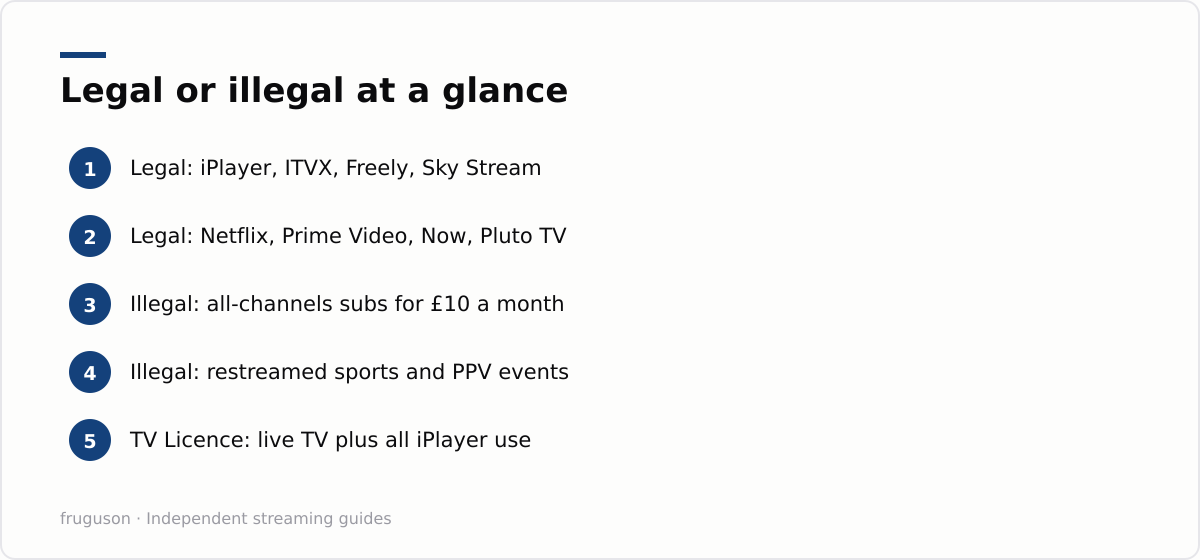
IPTV stands for internet protocol television. That is the whole definition: TV delivered over your broadband connection rather than through an aerial or a satellite dish. BBC iPlayer is IPTV. So is ITVX, and so is Sky Stream, the dish-free version of Sky. Freely, the internet successor to Freeview built into newer smart TVs, streams live channels the same way. Nobody is knocking on doors for watching Channel 4 online. The delivery method has no legal significance whatsoever. What matters is whether the company sending you those streams holds the rights to show them. Sellers of dodgy subscriptions lean hard on this confusion. IPTV sounds technical and neutral, which lets them claim “IPTV is 100% legal” with a straight face while selling something that plainly is not. One housekeeping point before we go further: you need a TV Licence to watch live broadcasts on any internet service, and you always need one for BBC iPlayer, even on catch-up.
So, is IPTV legal in the UK? The two-sided answer
Start with the legal side, because it is bigger than most people realise. Licensed IPTV services in Britain now cover almost everything worth watching. Broadcasters give you BBC iPlayer, ITVX, Channel 4 plus 5, all free with a TV Licence. Pay TV arrives through Sky Stream or Now, with discovery+ carrying TNT Sports for football. Free ad-supported platforms such as Pluto TV, Samsung TV Plus or The Roku Channel add thousands of hours at no cost, while Netflix, Prime Video plus Rakuten TV cover films. Every one of those companies pays rights holders for what it shows you. Some cost real money each month. All of them are legally watertight.
Now the other side. A pirate subscription typically offers ten thousand or more live channels, every Sky Sports channel plus PPV events included, for somewhere between £5 and £15 a month. That price is the tell. Sky and its rivals pay billions for Premier League rights alone. No legitimate business can retail the entire global TV market for the price of two coffees. These services restream content they never licensed, which makes selling them a crime and watching them, knowingly, an infringement as well.
What IPTV law UK searches actually turn up
Search for IPTV law UK and two statutes do most of the work. The Digital Economy Act 2017 raised the maximum sentence for online copyright infringement to ten years, a ceiling aimed squarely at people who distribute or sell. The Copyright, Designs and Patents Act 1988 covers the streams themselves; communicate a broadcast to the public without a licence and you infringe, full stop. Prosecutors also reach for the Fraud Act 2006 when subscriptions are sold dishonestly. Viewers sit lower on that ladder, but they are not off it. Watching a stream you know to be unlicensed is still infringement, and courts have begun treating it as worth punishing in its own right, as the Liverpool case below shows. The government examined all of this in its formal response to the call for views on illicit IPTV streaming devices, concluding that existing criminal law already covered the sale and use of such devices, which is why no shiny new offence ever appeared. The law did not need changing. It needed enforcing, and that is exactly what happened next.
Illegal IPTV consequences: enforcement got personal
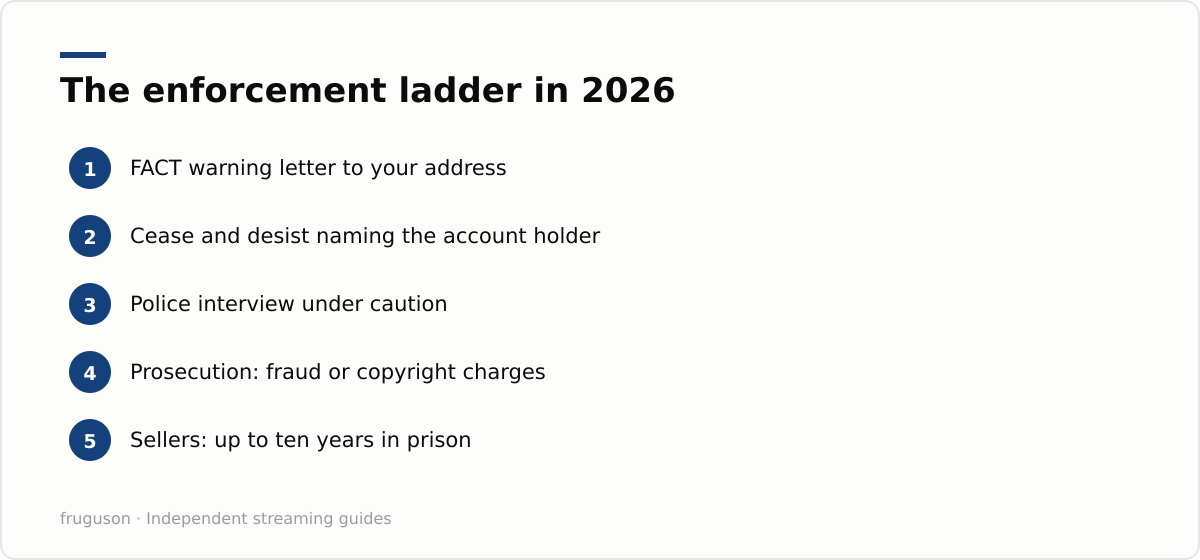
FACT, the Federation Against Copyright Theft, spent years going after sellers while leaving viewers largely alone. That changed in late 2025. Working with broadband providers and police, FACT sent warning letters to more than 1,000 UK households it had identified as watching pirated streams, a campaign reported in detail by ISPreview. The recipients were viewers, not resellers. Each letter asked the account holder to stop immediately and warned that continued use could bring further action. FACT documents its wider operations against sellers and suppliers on its own site, and the pace of those raids has not slowed.
Sellers face the sharp end. Under the Digital Economy Act 2017 they risk up to ten years in prison, and courts now hand out serious numbers. One Liverpool seller received a sentence of more than three years, and buried in that judgment sat a detail every casual viewer should read twice: the term included a concurrent sentence for watching the content himself. A British court decided that viewing pirated streams deserved prison time of its own, even though it ran alongside the larger sentence for selling.
One myth needs killing here: a VPN changes none of this. It hides your traffic from your broadband provider at best, and the letter campaign shows identification happens regardless. Legality depends on the licence behind the stream, never on how well you hide while watching it.
Beyond the courtroom, the damage stacks up quietly. Pay a pirate seller and your card details sit in a criminal’s database. The service can vanish overnight after a raid, with no refund and nobody to complain to. Sideloaded apps carry whatever extra code the seller felt like bundling. Taken together, the illegal IPTV consequences run from an awkward letter through malware and lost money all the way to a courtroom.
How to tell licensed IPTV services from pirate ones
Most people typing is IPTV legal in the UK into a search box are really asking about one specific service they have been offered. Five quick checks settle it almost every time.
| Check | Licensed service | Pirate subscription |
|---|---|---|
| Where it lives | Official app store on your TV or streamer | Sideloaded app, reseller panel, M3U link |
| Price against content | Priced like the rights it actually holds | Everything on earth for £5 to £15 a month |
| Payment | Card or direct debit through a real checkout | Crypto, gift cards, bank transfer to a stranger |
| Company footprint | Registered business with support and proper terms | A Telegram handle or a WhatsApp number |
| Marketing language | Names its own shows and channels | ”Anti-freeze servers”, “20,000+ channels” |
The app store test does the heaviest lifting. Pirate subscriptions almost never appear in your TV’s official store, because they could not survive review. Getting one running means sideloading an APK onto a Firestick or pasting an M3U playlist link into a generic player app. Those mechanisms exist for legitimate reasons; developers use them every day. When a seller requires them just to deliver mainstream channels, though, you have your answer: the consumer versions of those setups are almost always unlicensed. We will not walk you through the steps, and any site that does is selling you the risk along with the subscription. Stick to hardware that puts official apps first; everything in our IPTV equipment guide works that way straight out of the box.
Where that leaves you for the year ahead
Treat this as a buying decision rather than a courtroom drama. A Freely TV or a cheap streaming stick brings you the live broadcast channels for nothing beyond the TV Licence. Adding Now or discovery+ during the football season, then cancelling for summer, keeps most sports fans under roughly £35 a month, checked July 2026 against published pricing. Free ad-supported platforms fill the gaps without costing a penny. Our roundup of the best IPTV services in the UK for 2026 ranks every licensed option by price and catalogue, and if you would rather have a single recommendation than a list, start with our pick for the best IPTV provider in the UK. Once you have chosen, getting it running on a smart TV takes about ten minutes. Watch what you like, pay the people who made it, and never give a warning letter a second thought.
Frequently asked questions
Can I really get in trouble just for watching illegal IPTV?
Yes, and late 2025 proved it. FACT sent warning letters to over 1,000 UK households identified as viewers rather than sellers, and a Liverpool court gave one man a concurrent prison term for watching pirated content on top of his sentence for selling it. Knowingly streaming unlicensed content is copyright infringement even if you never sell anything.
Do I need a TV Licence for legal IPTV services?
You need one to watch any live broadcast over the internet, on any app or service. You also always need one for BBC iPlayer, including catch-up viewing. Purely on-demand services such as Netflix or Prime Video do not require a licence on their own.
How can I tell if an IPTV service is licensed?
Check where it lives and what it charges. A licensed service appears in your TV's official app store and its price matches the content it actually carries. If a seller wants crypto or a bank transfer for thousands of premium channels at £10 a month, treat it as unlicensed.
Summarize this post with:
Follow How To Watch Streaming on Google News so you never miss a new guide.
Leave a comment