Best IPTV Provider UK (2026): The Legit List and the £5 Trap
The "best IPTV provider" lists ranking £5-a-month services are marketing for pirate operations. Here's how to spot them, and which UK providers are actually safe to pay.
Contents
- The £5 provider lists, examined
- Which is the best IPTV provider UK households can trust?
- IPTV provider red flags: the 60-second check
- What using illegal IPTV UK services now costs
- How the reseller economy actually works
- Already paid one? Do this now
- Why we won’t name the resellers
- What a fair price actually looks like
- Our verdict
Search for the best IPTV provider UK viewers can buy and the results look strangely uniform: page after page of “tested and ranked” lists, each crowning a different £4.99-a-month service you’ve never heard of, each promising every channel on earth plus 4K sport. We checked those lists so you don’t have to. Not one of the services they recommend holds a UK licence. This guide explains what those “providers” really are, what using one now costs people, and which providers we’d actually put our own card details into.
The £5 provider lists, examined
We pulled the top-ranking provider round-ups in July 2026 and traced the services they promote. The pattern repeats. A site with no named authors publishes a “90-day test” of six services. The winner sells full Sky Sports, TNT Sports, every movie channel and thousands of international streams for less than the price of a coffee. Payment happens by card through a checkout page registered abroad, or by crypto. Support lives on Telegram.
Here’s the maths that matters: Sky pays billions for Premier League rights. A legitimate service reselling that content for £4.99 a month is not possible; not as a loss-leader, not as a promotion, not at scale. These operations stream pirated feeds, and the polished review sites ranking them are marketing for the same operators.
That’s the trap in this corner of the market. The search phrase sounds innocent. The results mostly aren’t.
Which is the best IPTV provider UK households can trust?
The legit IPTV providers in Britain are the ones you already know, because running licensed TV at national scale takes rights deals no anonymous reseller can sign. Our full comparison of legal UK services tests each one hands-on; the short version:
| Provider | What it is | From (checked Jul 2026) |
|---|---|---|
| Sky Stream | Full pay-TV over broadband, no dish | ~£15–31/mo |
| Now | Sky content on rolling monthly memberships | ~£10/mo |
| Freely | Free live BBC/ITV/C4/C5, built into newer TVs | Free |
| EE TV | TV bundled with EE broadband | With plan |
| Virgin Media Stream | Flexible bundles for Virgin customers | With plan |
For most households the practical answer is Sky Stream if you want everything in one box, or Now if you’d rather pay month by month. Sport fans usually end up mixing two services. None of them will vanish overnight with your card details, which brings us to the vetting test.
IPTV provider red flags: the 60-second check
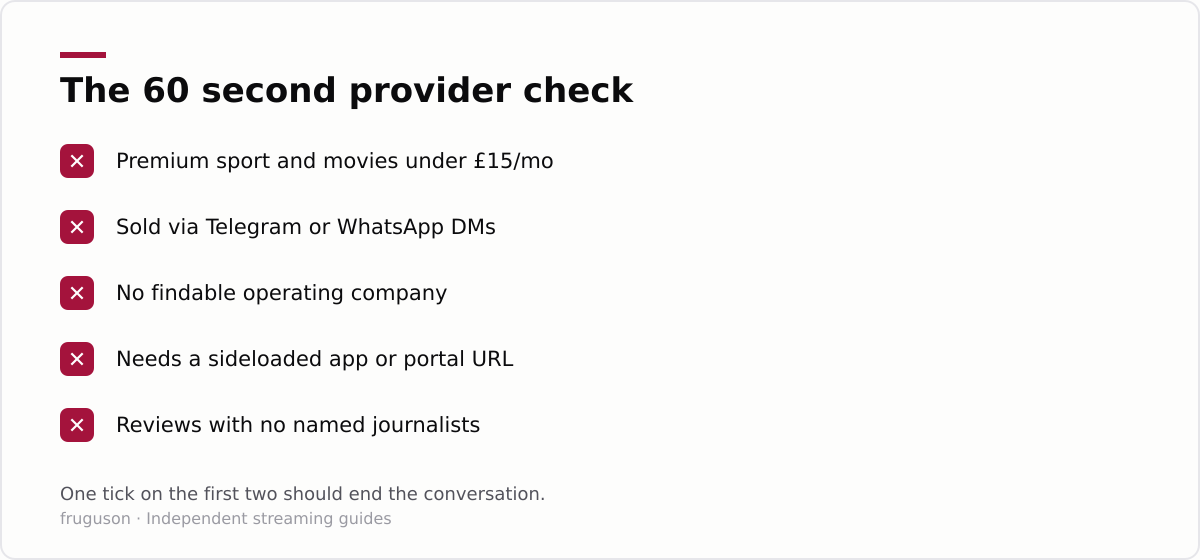
Before paying any streaming service, run it past these five questions. A single “yes” on the first two should end the conversation.
- Does it bundle premium sport and movies for under £15 a month? The rights maths fails. It’s pirated.
- Is it sold through Telegram, WhatsApp, or a reseller with a free trial by DM? Licensed providers have storefronts, not handlers.
- Can you find the operating company? A registered UK business with an address and support contact is the baseline. Anonymous checkout pages are not.
- Is the app in your TV’s official store? Every licensed UK service is. Anything demanding a sideloaded APK or an “M3U portal URL” is unlicensed by definition.
- Do the reviews name real journalists? Bylined reviews at established outlets count. A blog registered last spring with six glowing provider write-ups does not.
The pattern behind all five: legitimate providers survive scrutiny, resellers avoid it.
What using illegal IPTV UK services now costs
Enforcement used to target sellers. That changed. In late 2025, the Federation Against Copyright Theft sent warning letters to more than 1,000 UK households identified through a police-backed investigation, viewers, not vendors, warned to stop or face prosecution under the Fraud Act.
Sellers face worse. FACT’s crackdowns have produced real sentences, including three years and four months for a Liverpool man who sold modified Firesticks, with a concurrent term simply for watching the content himself.
The quieter cost shows up on bank statements. Roughly a third of UK consumers who admit to illegal streaming say they or someone they know ended up a victim of fraud or identity theft through it. You’re handing payment details to an anonymous operator whose business is already criminal. When the service disappears mid-season, and they routinely do, there’s no refund and nobody to complain to.
How the reseller economy actually works
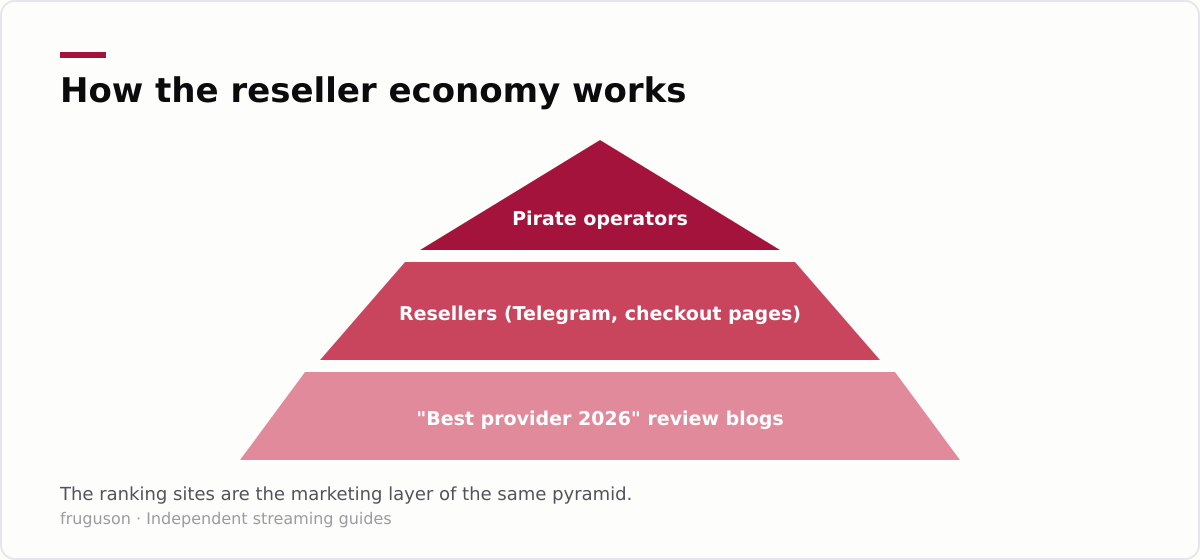
Understanding the machine explains the search results. At the top sit a handful of pirate operations running the actual streaming infrastructure. Below them, anyone can buy “credits” and become a reseller overnight; no technical skill needed, just a Telegram account and a willingness to take payments. The review blogs crowning a “best provider of 2026” are the marketing layer of the same pyramid: many are run by resellers reviewing themselves, which is why the winner changes from blog to blog but the prices never do.
That structure is also why the service you paid for vanishes so casually. Your reseller was one of hundreds, holds none of the infrastructure, and loses nothing by disappearing. The operation above them rebrands, the blogs republish with new names, and the cycle restarts within weeks. No legitimate market behaves this way, which makes the churn itself a useful tell.
Already paid one? Do this now
No judgment; the marketing is convincing and plenty of careful people have been caught. Three steps, in order. Cancel the card you used, not just the subscription; these operators have been linked to card fraud, and a cancelled subscription does not revoke their copy of your details. Watch your statements for small “test” charges over the next couple of months, since stolen card details are usually probed gently before being drained. And report it to Action Fraud if money goes missing, reports build the case files that investigations like FACT’s are made from.
Then delete the app or unplug the preloaded stick. Keeping it around “just for the sport” is exactly the usage the warning letters now target.
Why we won’t name the resellers
Readers occasionally ask why this guide describes the £5 services without naming any. Two reasons. Naming them is free advertising; these operations live and die on search visibility, and a warning article that ranks still sends them customers who skim. And any specific name would be stale within a month anyway, because rebranding is their survival mechanism. The pattern is durable even though the names aren’t, so the pattern is what we document. Learn the five red flags above and every future rebrand identifies itself.
What a fair price actually looks like
For calibration, here is what licensed television genuinely costs in Britain right now. The free tier is real and substantial: Freely, iPlayer and ITVX cover the main channels for nothing beyond the licence fee. Entertainment-focused households typically land between ten and twenty pounds a month on Now or entry Sky Stream plans. Sport is the expensive habit; a serious football season runs forty pounds a month and up across two services, and no licensed operator can undercut that by much because the rights bill is the same for everyone. Hold any tempting offer against those numbers. A price that beats the free tier while promising more than the sport tier is not a bargain; it is the tell.
Our verdict
Skip the reseller lists entirely. Pick from the licensed five above, start with a rolling contract, and spend the money you saved on not getting defrauded on a decent streaming stick instead. If you’ve already got a service in mind, our smart TV setup walkthrough gets any of the legal apps running in about ten minutes. And if a deal still tempts you: providers that fear a Companies House lookup do not deserve your card number.
Frequently asked questions
Are £5-a-month IPTV providers legal in the UK?
No. Services bundling premium sport, movies and thousands of channels for a few pounds a month cannot hold the broadcast rights they resell, Sky alone pays billions for Premier League coverage. They stream pirated feeds, and using them is illegal in the UK.
Can I get in trouble just for watching illegal IPTV?
Yes. In late 2025 the Federation Against Copyright Theft sent warning letters to more than 1,000 UK households identified through a police-backed investigation, citing possible prosecution under the Fraud Act 2006. Enforcement now reaches viewers, not only sellers.
What is the cheapest legal IPTV provider in the UK?
Freely is free, live BBC, ITV, Channel 4 and Channel 5 over broadband, built into many newer smart TVs (a TV Licence is still required for live viewing). Among paid options, Now's rolling monthly memberships are the cheapest way into Sky content.
Summarize this post with:
Follow How To Watch Streaming on Google News so you never miss a new guide.


Leave a comment