Does a Smart TV Need an Aerial? The Honest UK Answer (2026)
A smart TV needs no aerial to stream: Freely now carries over 70 live UK channels over broadband. Here is what you keep, what you lose, and when to keep an aerial.
Contents
- Does a smart TV need an aerial to work?
- What the aerial actually plugs into
- What can you watch without an aerial in 2026?
- Freeview, Freesat or Freely: which one needs an aerial?
- What do you actually lose without an aerial?
- Do you still need a TV Licence without an aerial?
- How much broadband do you need to replace an aerial?
- When an aerial is still worth keeping
- Recording live TV without an aerial
- The bottom line
If you have just unboxed a smart TV, or you are staring at a wall with no aerial socket, the question is fair: does a smart TV need an aerial at all? The short answer in 2026 is no. A smart TV powers on, connects to your broadband, and streams live and on-demand channels without an aerial anywhere in sight. The one job an aerial still does is feed the built-in Freeview tuner, and thanks to a service called Freely, even the main live channels no longer depend on it.
We set up TVs without aerials in a new-build flat, a rented house with a dead wall socket, and a spare room that never had a cable run. All three watched live BBC, ITV, Channel 4 and Channel 5 the same evening. Here is exactly what you get, what you give up, and when an aerial is still worth keeping.
Does a smart TV need an aerial to work?
No. In 2026 a smart TV needs only power and broadband to work, and Freely now streams live BBC, ITV, Channel 4 and Channel 5 over Wi-Fi with no aerial or dish attached (Freely, 2026). The aerial socket on the back is optional. Plug nothing into it and every app on the TV still runs.
Think of the aerial as one input among many. Your smart TV has HDMI ports, a network connection, and an RF (aerial) socket. Streaming apps travel down the network connection. The RF socket exists for a single purpose, which is receiving broadcast Freeview through the air. Skip that socket and you lose broadcast Freeview, nothing else.
That is the whole answer to a question people ask in a dozen slightly different ways. Whether you type “do you need an aerial for a smart TV” or “do smart TVs need an aerial”, the reply is the same: not to work, and not to watch the main channels, as long as you have a reliable internet connection.
What the aerial actually plugs into
The aerial feeds one component: the TV’s built-in Freeview tuner, which decodes channels broadcast over the air from your local transmitter (Freeview, 2026). No aerial means no tuner signal, so the classic Freeview channel list and its on-screen guide go dark. Everything delivered over the internet is untouched.
This matters because a lot of confusion comes from mixing up two different delivery methods. Broadcast TV is pushed out as radio waves and caught by an aerial. Streamed TV is pulled down your broadband line on demand. A smart TV can do both, but the two paths are completely separate. One dead aerial does not stop a single app from loading.
Older sets muddy this further. A TV from 2015 might have a Freeview tuner but a weak app store, while a 2025 set streams beautifully yet you never bother tuning the aerial. The hardware supports both routes. Which one you rely on is your choice, and increasingly people choose the broadband route and leave the aerial socket empty.
What can you watch without an aerial in 2026?
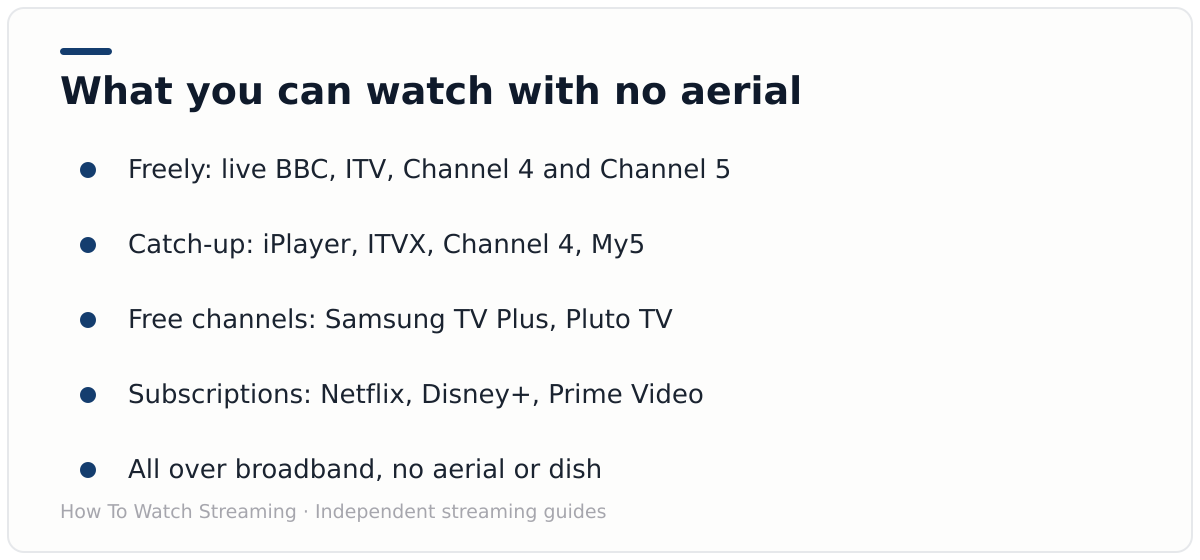
Plenty. Without an aerial you still get every major UK channel live through Freely, all four broadcaster catch-up apps, free ad-supported channels, and every subscription service, all over broadband (Freely, 2026). The aerial-free line-up in 2026 is close to complete.
Here is what arrives over your internet connection with no aerial:
- Freely: live BBC One and Two, ITV1, Channel 4, Channel 5 and more than 70 other live channels in one guide, launched by the BBC, ITV, Channel 4 and Channel 5 joint venture Everyone TV.
- Catch-up apps: BBC iPlayer, ITVX, Channel 4 and My5. Between them they carry every major UK channel live and on demand.
- Free ad-supported channels (FAST): Samsung TV Plus, Pluto TV and LG Channels, built into most modern smart TVs at no cost.
- Subscription apps: Netflix, Disney+, Prime Video, YouTube and the rest.
Freely is the big change. As of the Everyone TV announcement in October 2025, the platform carried more than 70 live channels and confirmed 10 more for 2026, including BLAZE, Bloomberg TV+ and Talking Pictures TV (Everyone TV, October 2025). For most households, that covers the channels they actually watch. For the full rundown of the service, see our explainer on what Freely TV is.
If your viewing is mostly the main channels plus a streaming service or two, an aerial adds almost nothing. Our test flat ran for a month on Freely and iPlayer alone and nobody missed the tuner.
Freeview, Freesat or Freely: which one needs an aerial?
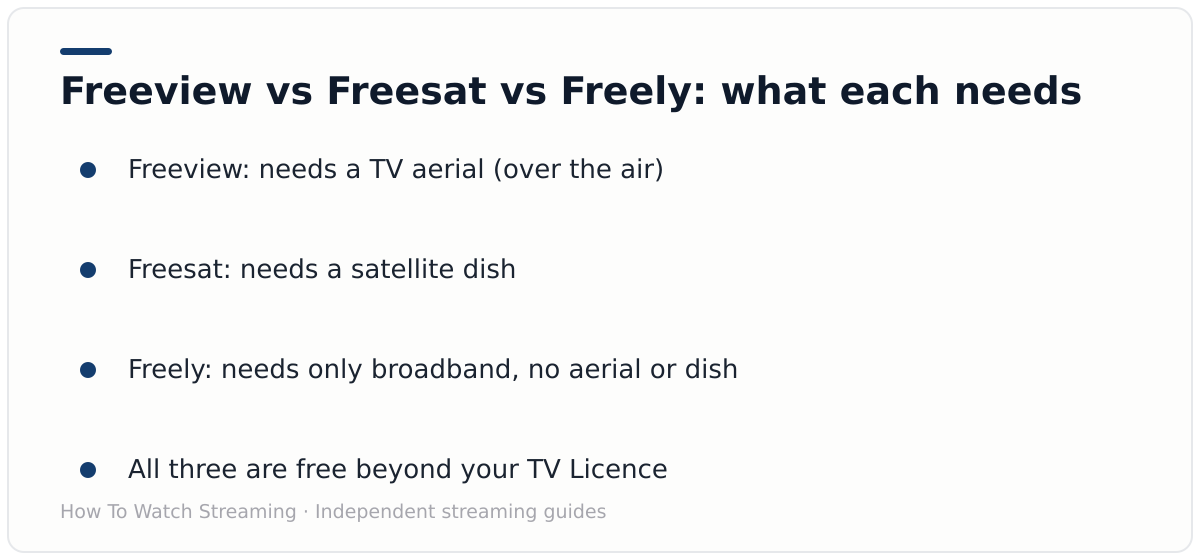
Only one of the three needs an aerial. Freeview requires a TV aerial, Freesat requires a satellite dish, and Freely requires neither, just broadband (Freesat, 2026). Getting these three names straight clears up most of the confusion around aerials.
| Service | What it needs | Live main channels | Extra kit |
|---|---|---|---|
| Freeview | A TV aerial | Yes, over the air | Aerial, possibly an amplifier |
| Freesat | A satellite dish | Yes, via satellite | Dish, alignment, cabling |
| Freely | Broadband only | Yes, over the internet | None beyond Wi-Fi |
Freely is best understood as Freeview without the aerial. It carries the same core public-service channels live, but it delivers them down your broadband line instead of through the air. That is why a new smart TV can show live BBC and ITV straight out of the box on Wi-Fi, with the aerial socket never touched.
One common trap is Freeview Play. People assume it means no aerial, but its live channels still arrive through the aerial; only its catch-up and on-demand run over the internet. Freely is the genuinely aerial-free live product, not Freeview Play.
What do you actually lose without an aerial?
Three things, and none of them are dealbreakers for most homes. Without an aerial you lose the over-the-air Freeview tuner, a handful of minor channels not yet on Freely, and live TV during a broadband outage (Freely, 2026). Weigh those against never climbing into a loft again.
The traditional Freeview tuner is the obvious loss. Over an aerial, Freeview carries more than 70 standard channels plus around 15 in HD, and that classic numbered guide disappears without the aerial (Freeview, 2026). Freely rebuilds most of it over broadband, but the specific line-ups differ, so a few niche or regional channels remain aerial-only for now while Freely expands through 2026.
The second loss is resilience. An aerial keeps working when your broadband drops or the power flickers back before the router does. Streaming needs a live connection, so if your internet is patchy, live TV goes with it. Freely also has no recording built in, offering roughly 15 minutes of pause and a 7-day scroll-back guide rather than a hard drive.
Our finding: In the rented house, the broadband dropped for two hours during a storm and Freely went dark, while a neighbour’s aerial-fed telly carried on. That single evening is the honest case for keeping a cheap indoor aerial as backup.
Do you still need a TV Licence without an aerial?
Yes, in most cases. A TV Licence is required to watch or record any live TV on any service, and to use BBC iPlayer at all, whether or not you have an aerial (TV Licensing, 2026). Cutting the aerial does not cut the licence.
The rule follows the type of viewing, not the delivery method. Watch anything live, on Freely, ITVX, a YouTube live stream or any channel as it is broadcast, and you need a licence. Open BBC iPlayer for anything, live or on demand, and you need one too. The official wording covers any programme watched “as it’s being shown.”
There is one narrow exception. If you only ever watch on-demand content on non-BBC services, for example Netflix box sets or catch-up on ITVX and Channel 4, and you never watch live and never touch iPlayer, you may not need a licence. It is a genuinely small window, so check the official TV Licensing checker before relying on it.
How much broadband do you need to replace an aerial?
Less than you might fear. Freely sets a minimum of 10 Mbps to stream its live and on-demand channels, and even 4K streaming tops out around 15 to 25 Mbps per stream (Freely, 2026). A typical fibre package runs several TVs at once.
The per-stream numbers are modest. Netflix recommends 3 Mbps for HD, 5 Mbps for Full HD, and 15 Mbps for 4K on a single stream (Netflix, 2026). Ofcom’s broadband guidance points the same way, and treats anything above 30 Mbps as superfast, comfortable for several screens at once (Ofcom, 2026).
What matters more than the headline speed is consistency. A steady 40 Mbps line streams several rooms without a stutter, while a fast line with congested Wi-Fi buffers at peak time. If you plan to run two or three TVs on Freely at once, add headroom and, where you can, wire the main TV with Ethernet. For the full kit picture, see our IPTV equipment guide for UK homes.
When an aerial is still worth keeping
In a few specific homes, yes. Keep an aerial if your broadband is slow or unreliable, you want to record over-the-air TV, or you need live telly to survive an internet outage (Freeview, 2026). For everyone else, the socket can stay empty.
Poor broadband is the clearest case. If your line sits below Freely’s 10 Mbps floor, or drops out often, an aerial gives you buffer-free live TV that does not care about your connection (Ofcom, 2026). Rural notspots and older buildings with weak lines are the obvious candidates.
The smart middle path is a cheap indoor aerial as a backup rather than a main source. Plug one into the RF socket and you restore the Freeview tuner for outages and for the few channels missing from Freely, while still streaming everything else. Reception depends on your distance to the transmitter, so it is hit and miss in weak-signal areas, but as a fallback it costs very little. If you are weighing the wider trade-offs, our comparison of IPTV versus cable and satellite in the UK puts the options side by side.
Recording live TV without an aerial
Here the aerial still has an edge. Freely has no built-in recorder, offering roughly 15 minutes of pause and a 7-day scroll-back guide instead of a hard drive (Freely, 2026). If you record a lot of live telly, that gap matters.
The catch-up apps soften it. Most live shows land on iPlayer, ITVX, Channel 4 or My5 within minutes of airing, so you rarely need to record them yourself. For anything that will not, a hybrid box such as the Humax Aura pairs an aerial and a Freeview recorder with streaming apps in one unit.
So if recording is central to how your household watches, keep the aerial and a recorder. If catch-up covers you, which it does for most homes, the streaming route loses very little. Our comparison of IPTV against cable and satellite weighs the trade-offs in full.
The bottom line
A smart TV does not need an aerial in 2026. It works, streams, and shows live BBC, ITV, Channel 4 and Channel 5 over broadband through Freely, with every catch-up and subscription app alongside. The aerial socket is now optional for most homes.
Keep an aerial only if your broadband is slow or flaky, you want to record over-the-air TV, or you want a fallback for outages. Otherwise, connect the TV to Wi-Fi, add Freely and the free apps, and leave the aerial socket empty. If you want the step-by-step, read our guide to getting Freeview on a smart TV without an aerial, and for the wider free line-up see our explainer on what Freely TV is.
Frequently asked questions
Do you need an aerial for a smart TV?
No. A smart TV works and streams entirely over broadband. An aerial is only needed to receive traditional over-the-air Freeview channels through the built-in tuner. Freely now streams the main live channels over Wi-Fi with no aerial.
Do smart TVs need an aerial to watch BBC and ITV?
Not anymore. Freely streams live BBC, ITV, Channel 4 and Channel 5 over broadband with no aerial, and iPlayer, ITVX, Channel 4 and My5 cover them on catch-up. A working internet connection replaces the aerial for the main channels.
Do you need an aerial for Freeview?
Yes. Freeview is broadcast over the air, so its built-in tuner needs a TV aerial. If you would rather skip the aerial, Freely delivers the same core live channels over broadband instead. Freely is effectively Freeview without the aerial.
What is the difference between Freeview, Freesat and Freely?
Freeview needs a TV aerial, Freesat needs a satellite dish, and Freely needs neither, only broadband. All three are free to watch beyond your TV Licence, but they reach your TV by three different routes.
Can I record live TV without an aerial?
Not through Freely, which offers about 15 minutes of pause and a 7-day catch-up guide rather than a recorder. To record over-the-air TV you still need an aerial plus a Freeview or Freesat recorder, or a hybrid box such as the Humax Aura.
Do I need a TV Licence if I only stream?
Yes, if you watch any live TV or use BBC iPlayer. A licence covers live viewing on any service and all iPlayer use, aerial or not. Only on-demand viewing on non-BBC services is exempt.
Summarize this post with:
Follow How To Watch Streaming on Google News so you never miss a new guide.


Leave a comment