Can You Record IPTV? UK Recording Options in 2026
A plain-spoken guide to why UK streaming services dropped the record button, and what viewers in 2026 actually get in its place.
Contents
- Why the record button disappeared
- How to record streaming TV in 2026: the four real routes
- Sky Stream playlists versus Sky Q recordings
- Freely restart and the catch up vs recording question
- When a Freesat or aerial PVR still makes sense
- How much a hard drive recorder actually holds
- The realistic setup for 2026
Ask a Sky Q veteran what they miss most after moving to a streaming puck and the answer is nearly always the same: the recordings. For two decades the planner was the heart of British telly. Series link a drama, record the football, skip the adverts on Sunday morning. Then the boxes went internet-only and the record button quietly vanished. If you want to record streaming TV in 2026, the honest answer is that on most UK services you cannot, at least not in the way you used to. What you get instead is a mix of playlists and time-limited catch-up. This guide walks through what each route really offers, where genuine recordings still exist, and how much a box with a hard drive actually keeps.
Why the record button disappeared
Recording made sense when TV arrived through an aerial or a dish. The broadcast passed your house once, so the box grabbed a copy and kept it on a hard drive you controlled. Internet TV works differently. Every programme already sits on a server, ready to stream whenever you ask, so the platforms argue there is nothing left to record. Underneath that convenience sits a rights story. Broadcasters license shows for defined on-demand windows, and letting viewers keep permanent local copies would cut straight across those deals, so streaming hardware leaves the feature out on purpose.
True cloud recording TV, where the service stores a personal copy of a broadcast against your account, is common in America but never took hold here. UK platforms went the other way and negotiated catch-up rights instead. The practical difference is enormous. A recording is yours until you delete it. A catch-up entry belongs to the broadcaster, and it can vanish the moment a licensing window closes, whether you have finished the series or not.
How to record streaming TV in 2026: the four real routes
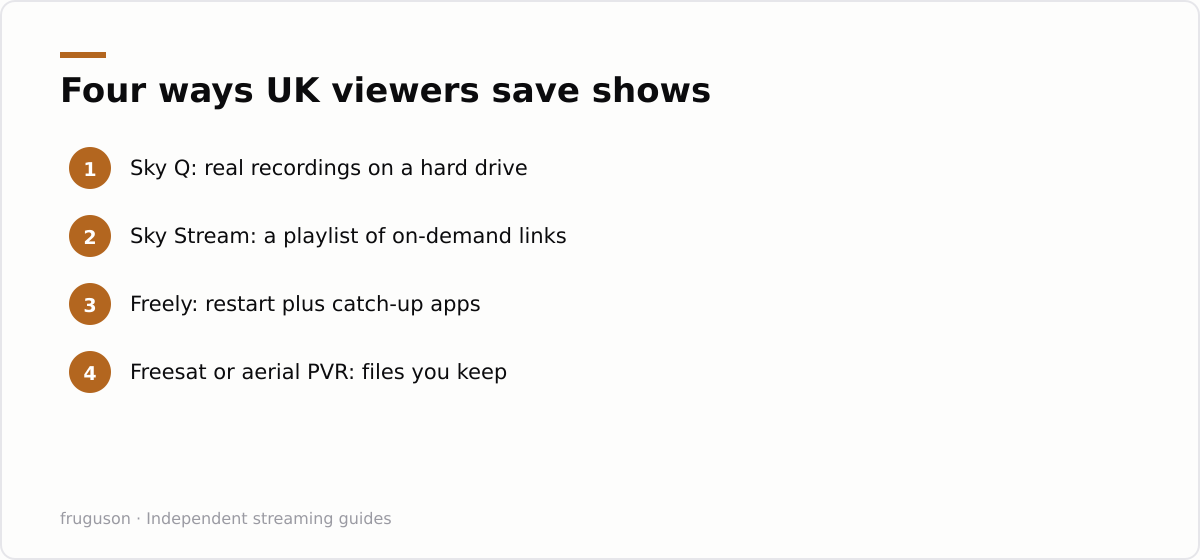
Strip away the marketing and UK viewers have four workable options. Two involve actual files on an actual disk. The other two are clever substitutes that imitate recording without ever handing you a copy.
| Route | What you actually get | Do you keep it? |
|---|---|---|
| Sky Q (satellite) | Real recordings on a 1TB or 2TB hard drive | Yes, until you delete them |
| Sky Stream / Now | A playlist pointing at on-demand copies | No, entries expire with rights |
| Freely | Restart for live shows plus catch-up apps | No, windows are time-limited |
| Freesat or aerial PVR | Recordings stored on your own box | Yes, kept locally |
Skip the third-party “record any stream” apps and HDMI capture gadgets before you get your hopes up. Protected services deliberately output a black screen to screen-recorders and to many capture boxes, so what you save is usually either nothing at all or a soft, juddering copy at a fraction of the original quality. Even where a grab technically works, you end up with a huge unlabelled video file and none of the series-link, chapter-skip and auto-delete conveniences that make a proper recorder pleasant to live with. For anything you genuinely want to keep, the four routes in the table above are the ones worth your time.
App downloads muddy the water too. Netflix, Prime Video and BBC iPlayer all let you save programmes to a phone or tablet for offline viewing, which sounds like recording until you look closer. Downloads expire, sometimes within 48 hours of first play. They stay locked inside the app and vanish if a title leaves the service or your subscription lapses. Useful on a train, certainly. A substitute for a shelf of recordings, no.
Sky Stream playlists versus Sky Q recordings
Sky currently sells two very different ideas under one brand. Sky Q is the old model, a dish on the wall and a hard drive in the box. Press record and the file lands on your own storage, adverts included, ready to be skipped at will. Recordings survive channel reshuffles and stay watchable for years, which is why plenty of households refuse to hand the box back.
Its newer sibling swaps the disk for a playlist. Sky Stream, described on Sky’s own site at sky.com/tv/stream, copies nothing when you tap the plus button on a programme. It bookmarks the on-demand version, and the puck fetches that stream every time you press play. The experience feels close to a planner until the differences bite. A show drops out of your playlist when its rights window ends. Live sport often cannot be bookmarked at all. Ad skipping on playlist content is a paid extra, roughly £5 a month checked July 2026, because you are watching a broadcaster’s stream rather than your own file. You cannot record streaming TV onto a Stream puck in any real sense, and Sky is careful never to claim otherwise. That said, the puck suits plenty of homes; our Sky Stream puck setup guide explains what it does brilliantly.
Freely restart and the catch up vs recording question
Freely, the broadband successor to Freeview built by the public service broadcasters, takes a third path. No disk, no playlist. Live channels stream over your connection, and supported programmes offer restart, which jumps you back to the beginning of a show already in progress. For everything beyond that, Freely leans on the broadcasters’ own apps, with BBC iPlayer, ITVX, Channel 4 and 5 built into the guide.
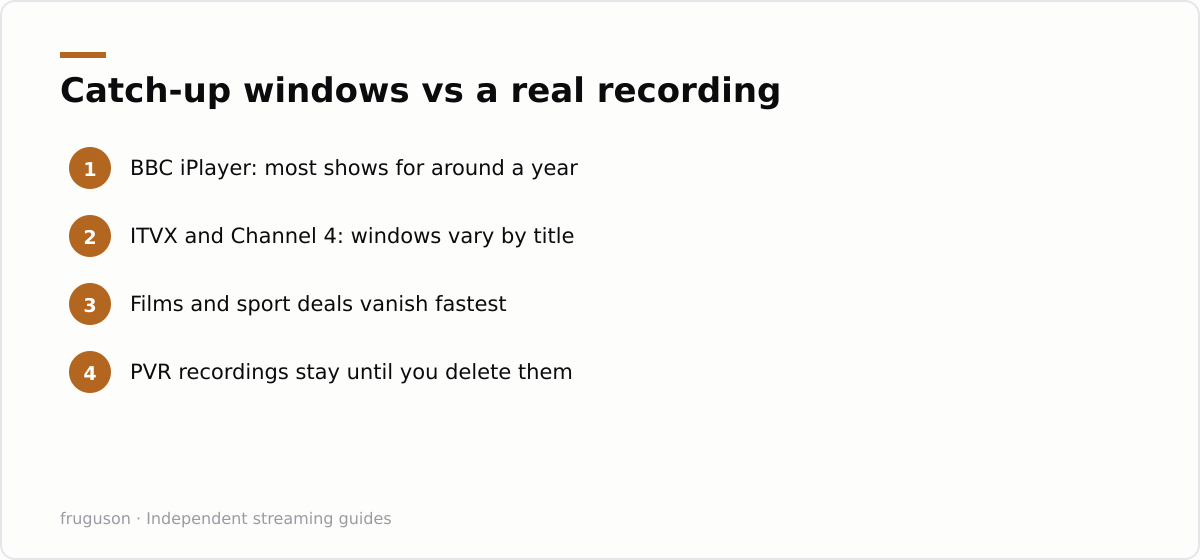
That framing makes the catch up vs recording trade-off easy to judge. Catch-up is generous while it lasts. BBC iPlayer keeps most programmes for around a year, and box sets often stay longer. ITVX and Channel 4 vary title by title; some shows hang around for months while others are gone within weeks. Films and imported dramas tend to vanish fastest, and anything touched by sport rights goes quicker still. A recording never behaves like that, which is the whole argument for keeping one box with a disk in the house. Our UK catch-up apps guide tracks the current windows service by service, because they genuinely shift as deals get renewed.
When a Freesat or aerial PVR still makes sense
Proper recording never died in Britain; it simply retreated to the platforms that still broadcast. A Freesat 4K TV box with a hard drive records from the dish and keeps hundreds of hours until you choose to bin them. On the aerial side, Freeview Play recorders such as Manhattan’s T3-R do the same job from a rooftop antenna. Expect to pay somewhere in the £100-250 range depending on storage, checked July 2026, with no subscription needed for the core recording function.
Who should bother? Anyone on slow or capped broadband, because a PVR takes nothing from your connection. Anyone who archives long series to watch months later. Anyone who wants ad skipping without a monthly fee, or who hates a show disappearing halfway through a binge. If that sounds familiar, our Freeview vs Freely vs Freesat comparison explains which signal route fits your house before you spend a penny.
How much a hard drive recorder actually holds
Storage is the number that decides how a recorder fits your household, and the box quotes it in hours rather than gigabytes on its own menus. As a rough guide, standard-definition channels use somewhere around 1.5GB an hour and HD two to three times that, so a 500GB drive holds a few hundred hours of SD or roughly a hundred hours of HD, while the 1TB and 2TB drives in a Sky Q or a Freesat box comfortably double or quadruple that. Series link is what keeps all that space manageable: point it at a drama and the box records each new episode automatically, and an auto-delete setting clears watched entries to claw the room back. The catch worth knowing before you trust a recorder with anything precious is that the files are tied to the box that made them. They sit in an encrypted broadcast format the manufacturer locks down, so you cannot usually copy them onto a laptop or a memory stick, and when the box eventually dies its library tends to die with it. For a programme that genuinely matters years from now, an official download or a shop-bought copy is a safer home than any recorder’s disk.
The realistic setup for 2026
Decide what keeping a programme actually means to you, then buy for that. If a show expiring after ninety days would genuinely annoy you, put a cheap aerial or Freesat recorder next to the telly and let it quietly hoard the things you care about while a streaming puck handles everything else. If you cannot remember the last time you rewatched anything, skip the extra box; year-long iPlayer windows and playlists will cover you and you will never miss the disk. Either way, stop waiting for the big platforms to change course. The rights deals that killed local copies are the same deals that keep monthly prices down, so the trade is permanent. To record streaming TV in any lasting way today means broadcast kit with a hard drive, and everything else means borrowing a copy for as long as the window stays open.
Frequently asked questions
Can Sky Stream record programmes like Sky Q does?
No. Sky Stream has no hard drive, so the plus button only adds a show's on-demand version to a playlist. The entry disappears when the broadcaster's rights window closes, which is the key difference from a Sky Q recording that stays on the box until you delete it.
Can I copy my recordings off the box to keep them?
Usually not. Sky Q, Freesat and Freeview recorders store programmes in an encrypted broadcast format tied to that one box, so they cannot be freely copied to a laptop or USB drive. Recordings stay watchable until you delete them, but if the unit fails its library generally goes with it, so buy or download anything you want to keep for good.
What is the cheapest way to keep permanent recordings in 2026?
An aerial Freeview Play recorder if you have a rooftop antenna, or a Freesat box with a hard drive if you use a dish. Both store recordings locally with no monthly fee for the core function, and prices sat roughly between £100 and £250 when checked in July 2026.
Summarize this post with:
Follow How To Watch Streaming on Google News so you never miss a new guide.



Leave a comment