Freeview vs Freely vs Freesat: Which Free TV Route in 2026?
Freeview vs Freely vs Freesat compared for 2026: what each free UK TV platform costs, the kit it needs and which route quietly fits your home.
Contents
Three services promise free television in Britain, and the names blur together fast. Freeview vs Freely is the comparison most people actually need in 2026, because those two now sit at the centre of how ordinary homes pull in channels without a monthly bill. Freesat is the third name in the mix, built for homes that cannot get a clean aerial signal. This guide sorts what each platform is and what kit it needs. It also shows where the whole system is drifting.
Freeview vs Freely: the short version
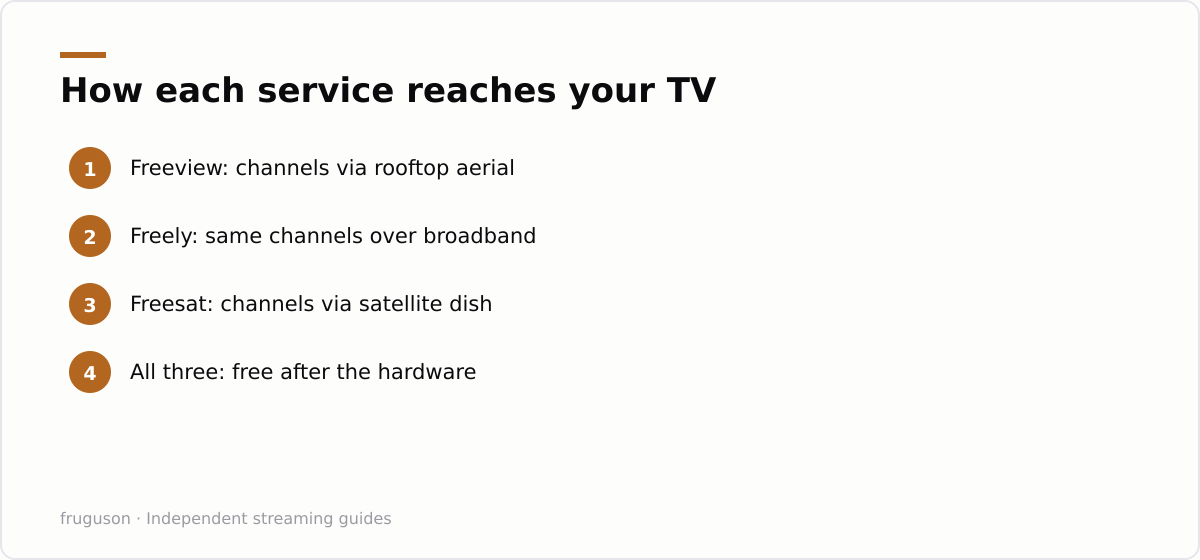
Freeview relies on your rooftop aerial to carry channels. Freely sends the same public-service channels over your broadband instead. Both are free once the hardware is paid for. The catch is small but real: Freely lives inside newer smart-tv sets, while Freeview reaches almost any television made in the last fifteen years. If your set is recent and your internet is steady, the two feel almost identical on the sofa. The plumbing behind them could not be more different.
That difference is the story of the next decade. Ofcom has tracked the slow shift from broadcast aerials toward internet delivery for years, and you can read the pattern in its Media Nations UK report at https://www.ofcom.org.uk/media-use-and-attitudes/media-habits-adults/medianations. Younger homes already treat streaming as the default. Older homes still lean on the aerial. Freely is the industry’s answer to that split.
What Freeview actually is
This is the aerial-fed service that replaced analogue at the digital switchover. It carries the main channels plus a long list of secondary and radio stations, all pulled from the air by your rooftop or loft aerial. No internet is needed for live viewing, which matters in areas with patchy broadband. A basic Freeview tuner is baked into nearly every TV sold since 2010, so most people already own one without thinking about it. Reception depends on your local transmitter, so a quick postcode coverage check tells you which channels to expect before you rely on it.
Two tiers are worth knowing. Standard Freeview gives you the core lineup of live channels. Freeview Play adds catch-up apps such as BBC iPlayer, ITVX, Channel 4 and 5 through a backwards scroll in the guide, as long as the set is connected to your home network. That catch-up layer needs internet, but the live channels keep working even if the router dies.
What Freely brings
Freely is the newer platform, launched by the same broadcasters that run Freeview, and it drops the aerial entirely. Every channel arrives over your broadband connection. The live guide looks and behaves like a traditional programme grid, except the stream comes down the wire rather than off the roof. That single change gives you things aerials never could: a unified guide that blends live and on-demand, plus channels that do not depend on your local transmitter’s reach.
You need a Freely-enabled TV to use it. At launch the supported models came from a handful of brands, and the list keeps growing each year. You can check the current supported sets on the official site at https://www.freely.co.uk/. No set-top box exists for it yet in most homes, so an older television cannot join in without replacing the whole panel. Because the stream travels over the internet, a Freely picture can hold up in spots where the aerial is marginal, provided the broadband is solid. That hardware gate is the main reason Freeview still dominates the installed base. We cover the platform in more depth in Freely TV explained if you want the full picture.
Freesat explained
Here is where the third option fits. Freesat explained simply: it is the satellite version of free television, run as a joint venture between the BBC and ITV. Instead of an aerial or broadband, a dish on your wall pulls channels down from a satellite. That reach is its whole point. Homes tucked in valleys or far from a terrestrial transmitter often get a poor Freeview signal but a perfectly strong satellite one.
Freesat needs a dish and a compatible box or TV. If a dish is already bolted to your house from an old Sky install, the cost of switching is mostly just the receiver. The channel lineup overlaps heavily with Freeview, though the exact roster differs a little, and catch-up apps are built into the newer boxes. Newer Freesat boxes add recording and some 4K content, so the gap with a paid satellite service is narrower than it once was. Installation usually wants a clear line of sight to the satellite, which a professional fitter can sort in an afternoon. For a rural home with weak terrestrial coverage, Freesat is frequently the most reliable free route of the three.
Aerial vs broadband TV: the real trade-off
The honest framing here is aerial vs broadband TV, because that is the fork every household faces. Aerial delivery is rock solid and needs no data allowance, but it is capped by your transmitter and cannot easily fold in on-demand content. Broadband delivery is flexible and future-friendly, yet it leans on a stable connection and counts against any data limits your line carries. Neither is wrong. They simply suit different homes.
| Route | Delivery | Kit needed | Best for |
|---|---|---|---|
| Freeview | Rooftop aerial | Any recent TV or box | Homes with a good aerial and any broadband |
| Freely | Home broadband | A Freely-enabled TV | Newer sets on steady internet, no spare aerial |
| Freesat | Satellite dish | Dish plus box or TV | Rural or poor-signal areas |
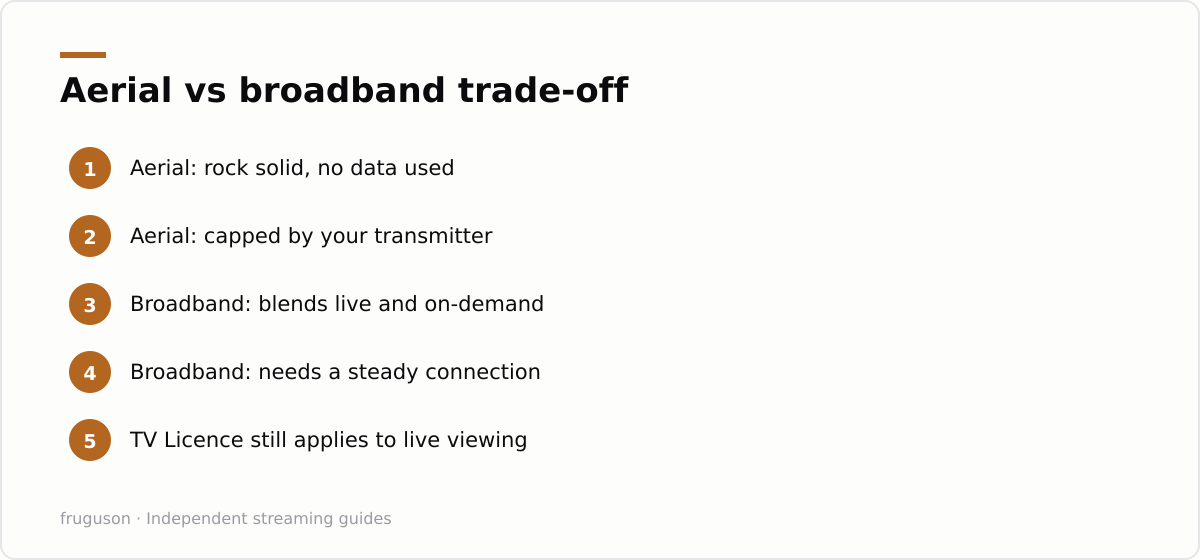
None of these three charges a subscription. One practical wrinkle is data: a household on a capped mobile-broadband line should weigh how much streaming eats into that allowance before leaning on Freely full time.
Which free route fits your home
Start with what you already own. A working aerial and a TV from the last decade means Freeview costs you nothing, so it is the obvious default among the free TV options UK households can pick from. If you are buying a new set anyway, choosing a Freely model future-proofs you and folds live and on-demand into one guide. If your terrestrial signal is genuinely weak, Freesat earns its dish. Room count matters too, since a second or third TV may need its own tuner or box.
Broadband speed decides a lot. The Freeview vs Freely choice often turns on it, since Freely needs enough headroom for a steady stream. Most modern fibre and even decent copper lines manage that without drama. A shaky connection makes the aerial look wise again, and older relatives on a slow line are usually happier on Freeview, where nothing buffers.
One practical point ties the three together: all of them are free to use once you have the hardware, with no monthly bill and no account. The differences come down to how they reach your TV — an aerial for Freeview, broadband for Freely, a satellite dish for Freesat — and how modern the on-screen guide and catch-up links feel. If you later want a paid layer on top of these free platforms, our roundup of the best IPTV services UK 2026 covers the options worth paying for, and the IPTV equipment guide UK explains what hardware is worth buying.
Where this is heading
Aerial television is not dead, but the momentum has clearly moved. Freely is the broadcasters betting that the rooftop antenna fades the way the analogue signal did, replaced quietly as people swap old televisions for new ones. That transition runs on the length of a television’s lifespan, so expect a long overlap rather than a hard switch-off date. If you are weighing a new set purely for this, a Freely badge is a reasonable tick on the spec sheet, though it should not be the only one. For most homes reading this in 2026, the Freeview vs Freely question has a cheap, boring answer: keep the Freeview you already have, and let your next television decide whether Freely takes over. Check any current prices before you buy, since figures move through the year.
Frequently asked questions
Do Freeview, Freely and Freesat carry the same channels?
Their core line-ups overlap heavily, since all three carry the main public-service channels. The exact roster differs at the edges: Freeview and Freesat vary a little on their secondary channels, while Freely's streamed line-up started smaller in 2024 and has grown each year. Check a platform's current channel list before switching for one specific channel.
Is Freely replacing Freeview?
Not yet, and not on a fixed date. Freely is the broadcasters' long-term move toward internet delivery, but Freeview still reaches far more homes because it works on older televisions. Expect a long overlap as people gradually swap old sets for Freely-enabled ones.
Which free service is best if my broadband is slow?
Freeview is usually the safer pick, since its live channels come off the aerial and never buffer. Freely leans on a steady connection, so a shaky line can interrupt playback. If your terrestrial signal is also weak, Freesat via a satellite dish is worth considering instead.
Summarize this post with:
Follow How To Watch Streaming on Google News so you never miss a new guide.


Leave a comment