TV Licence Rules for Streaming: What You Pay For in 2026
A plain-spoken guide to when streaming needs a TV licence in the UK, when it legally does not, and what those enforcement letters really mean.
Contents
- The two triggers that decide everything
- Trigger one: live TV on any service
- Trigger two: BBC iPlayer, live or on demand
- TV licence streaming rules by service
- When you can watch TV without licence cover
- The edge cases that catch people out
- Students
- Second homes
- Recording live TV
- Live sport on Prime Video
- What enforcement letters actually are
- Check your answer, then act on it
Two questions decide the whole thing. Do you ever watch anything live, on any app or channel? Do you ever open BBC iPlayer? The TV licence streaming rules for 2026 hang on those two triggers and nothing else. Every edge case, from student halls to the stern letters on the doormat, flows out of them. Plenty of UK households now stream everything and genuinely need the licence they pay for. Plenty of others pay for cover the law never asked them to have. This guide sets out where the line sits, without the scare stories.
The two triggers that decide everything
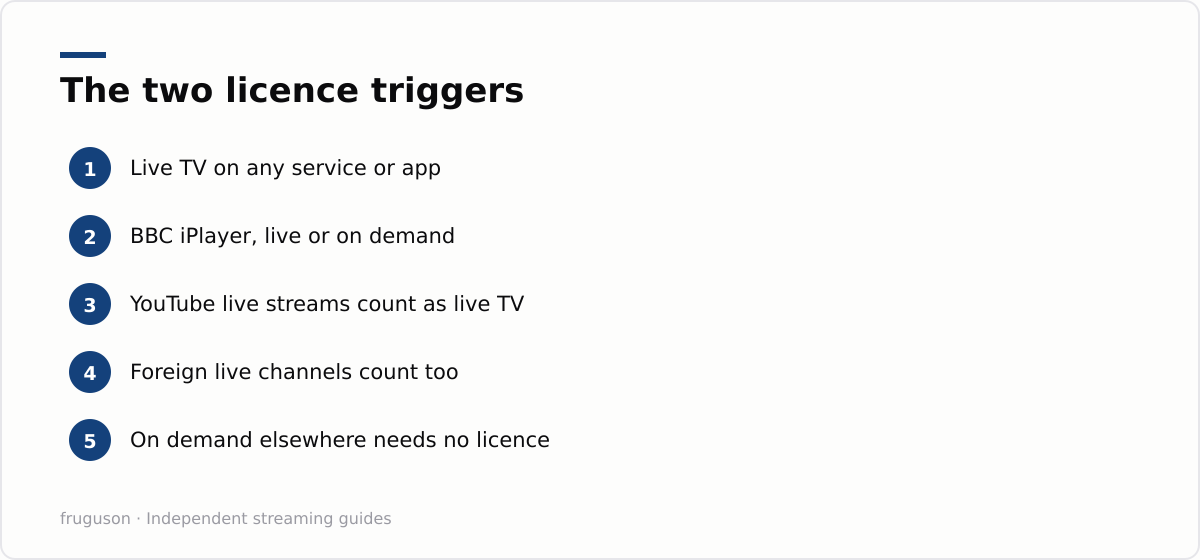
UK law does not care which app you stream through, which box sits under the telly or whether you own an aerial at all. It cares about two behaviours. Most TV licence streaming myths grow in the gap between what those behaviours actually are and what people assume they are.
Trigger one: live TV on any service
A licence is required the moment you watch or record programmes as they are shown to the public. Live is the word doing the heavy lifting. It covers the obvious cases, such as BBC One through an aerial or ITV1 streamed inside ITVX. It also covers plenty that surprises people. Watching a live stream on YouTube counts. A foreign news channel streamed live over the internet counts, even though it never touches a British transmitter. So do the linear channels on Pluto TV, Samsung TV Plus and LG Channels, because a scheduled stream that every viewer sees at the same moment is live television in the legal sense. Simulcast streams inside apps sit on the wrong side of the line too, and so does anything labelled as a live channel within Now or Sky Stream.
Hardware makes no difference. If the content is live, the requirement applies on a phone just as it does on a 65-inch telly. Freely deserves a special mention here, since it streams the main terrestrial channels live over broadband and therefore sits inside the rules exactly as an aerial would.
Trigger two: BBC iPlayer, live or on demand
iPlayer is the odd one out. Since 2016, iPlayer licence rules have covered everything on the platform, including on-demand programmes watched weeks after broadcast. Catch-up on ITVX needs no licence. Catch-up on iPlayer does. One episode of a decade-old sitcom on iPlayer puts you inside the net just as firmly as the ten o’clock news watched live. The BBC pushed for this change precisely because on-demand viewing was eroding the fee, and it remains the single most misunderstood part of the whole system.
TV licence streaming rules by service
Here is how the two triggers play out across the apps a UK household actually uses. Once you spot the pattern, TV licence streaming stops being confusing: live always needs cover, on demand never does, and iPlayer needs it for both.
| Service | Live viewing | On demand only |
|---|---|---|
| BBC iPlayer | Licence needed | Licence needed |
| ITVX | Licence needed | No licence |
| Channel 4 and 5 | Licence needed | No licence |
| Netflix | Licence needed (live events) | No licence |
| Prime Video | Licence needed (live sport) | No licence |
| Now and Sky Stream | Licence needed | No licence |
| YouTube | Licence needed (live streams) | No licence |
| Pluto TV, Samsung TV Plus | Licence needed (linear channels) | No licence |
discovery+ shows the same split, incidentally: its boxsets are on demand, while the TNT Sports channels carried inside it are live broadcasts in every sense that matters. Aggregator platforms follow the same logic. Most of the services in our roundup of the best IPTV services in the UK are built around live linear channels, which is precisely the behaviour that triggers the fee. A paid subscription changes nothing, and neither does the app being modern or foreign.
When you can watch TV without licence cover
It is entirely legal to watch TV without licence cover, provided your viewing follows one strict recipe. Stream on demand only. Never open iPlayer. Never press play on anything described as live, not even for a minute.
That still leaves a huge amount of television. Netflix and Disney+ qualify almost entirely. The catch-up sections of ITVX and Channel 4 qualify too, as do YouTube videos that have finished streaming and films rented through Rakuten TV or The Roku Channel. So, do I need a TV licence if my household genuinely watches this way? No, and you can tell TV Licensing so by filing a No Licence Needed declaration, which thins out the letters even if it does not stop them forever. The declaration lapses after roughly two years, so renewing it becomes part of the routine.
Money is the obvious motive, so be clear-eyed about it. The fee has sat in the region of £175 a year recently (checked July 2026), and it tends to rise each April, so treat that figure as a ballpark rather than a quote. Against that cost, weigh how much live sport and iPlayer actually feature in your week. One live match a month makes the licence unavoidable for many households, and pretending otherwise is how people end up giving a dishonest answer at their own front door.
The edge cases that catch people out
Students
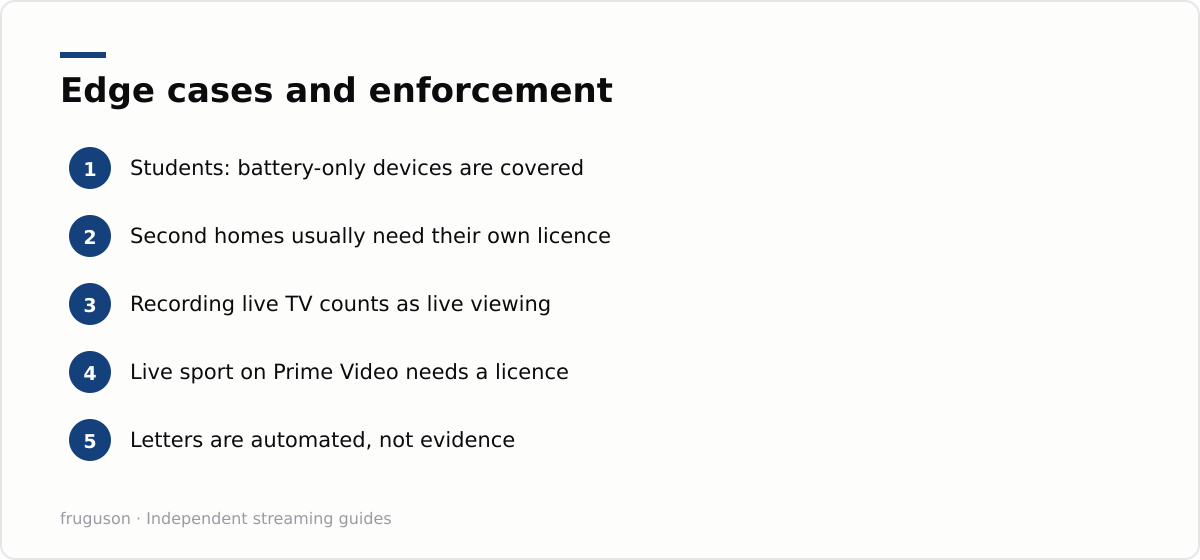
Cover is tied to a single address. Your parents’ licence stays at your parents’ house, so a room in halls or a shared student house normally needs its own if either trigger applies there. One genuine exception exists: a device running purely on its own battery, not plugged into the mains and not connected to an aerial, is covered by the licence at your out-of-term address. A phone on battery watching live TV in halls is covered. The same phone on charge is not. Odd, but that is the rule as TV Licensing itself states it.
Second homes
Holiday flats and second homes need their own licence if anyone watches live TV or iPlayer there, because cover follows the address rather than the person. Touring caravans and boats get a narrow concession, provided nobody is watching at the main home at the same time.
Recording live TV
Recording counts as live viewing regardless of when you press play. Setting a PVR or a cloud recording to capture a live broadcast triggers the requirement at the moment of capture, even if the programme then sits unwatched for a month.
Live sport on Prime Video
Prime Video is mostly an on-demand library, which needs no licence on its own. Its live sport is different. A live fixture on Prime is live television in the legal sense, so watching it unlicensed is an offence, exactly as if the match were on ITV1. The same logic applies to the live events Netflix has started running in recent years.
What enforcement letters actually are
Unlicensed addresses receive letters, and the letters escalate: a polite reminder first, then talk of investigations, then dates on which an officer may visit. Understand what these are before losing any sleep. They are automated mailings sent on a repeating cycle to every address without a licence or a current declaration on file. No human has assessed your household before one lands on the mat. A letter is not evidence that anybody believes you are breaking the law; it is a mail merge. If you have filed a No Licence Needed declaration and letters still arrive occasionally, that is normal too, and it usually means the declaration has expired rather than that you are suspected of anything.
Visiting officers are contractors rather than police. They hold no right of entry without a court warrant, which is granted rarely, and you are under no obligation to let them in or to answer questions at the door. None of this makes evasion sensible. Watching live TV or iPlayer without cover remains a criminal offence in England and Wales, carrying a fine of up to £1,000 plus costs on conviction, and Scotland and Northern Ireland run similar regimes of their own. The strong position is simply knowing which side of the two triggers your household sits on and being able to say so truthfully.
Check your answer, then act on it
Work through the official checker at tvlicensing.co.uk. It asks a handful of questions about live viewing and iPlayer, then gives a definitive answer in about two minutes, straight from the organisation that would otherwise be writing to you. If the answer is yes, paying monthly by direct debit softens the cost considerably. If the answer is no, file the No Licence Needed declaration the same day and stream on demand with a clear conscience.
One closing thought from the hands-on side. If live channels are staying part of your routine, make them earn the fee: a properly set-up telly beats juggling apps and remotes, and our walkthrough on setting up IPTV on a smart TV covers the legal apps that handle live channels well. Match your paperwork to your habits, and the doormat letters can go straight into the recycling.
Frequently asked questions
Do I need a TV licence for Netflix and Disney+?
No, on-demand films and series on Netflix or Disney+ do not require a TV licence. The requirement only appears if you watch live content, such as the live events Netflix now runs, or if you use BBC iPlayer. Households that stream on demand only can legally go without one.
Does live sport on Prime Video need a TV licence?
Yes. A live fixture streamed on Prime Video counts as live television under UK law, exactly as if it were shown on ITV1. Prime's on-demand films and series remain licence-free, so the trigger is only the live content.
Can students use their parents' TV licence at university?
Usually not, because a licence covers one address. The single exception is a device running purely on its own battery, unplugged from the mains and not connected to an aerial, which is covered by the licence at the parental home. The moment that device goes on charge while viewing, it needs its own cover.
Summarize this post with:
Follow How To Watch Streaming on Google News so you never miss a new guide.
Leave a comment