VPNs and IPTV in the UK: The Lines People Get Wrong
A plain-English look at where a VPN for IPTV sits with UK law: the tool is legal, but masking pirate streams or dodging geo blocks is not.
Contents
- Is a VPN legal UK households can rely on?
- What a VPN for IPTV actually does
- Geo blocking rules and why the terms still bind you
- Streaming with VPN on services you actually pay for
- The pirate IPTV trap a VPN will not fix
- Does a VPN make you truly anonymous?
- The verdict: keep the tool, drop the wishful thinking
A VPN for IPTV sits at the centre of a lot of muddled advice online. People blur two separate questions into one. The first asks whether the tool itself is allowed. The second asks whether what you do with it stays inside the law and inside your service agreement. Those are not the same. This guide keeps them apart in plain terms, so you can decide with a clear head rather than a nervous one.
Is a VPN legal UK households can rely on?
Yes. A VPN, a virtual private network, is ordinary legal software. Banks build their remote access on the same technology. Millions of employees switch one on before they touch a work laptop. It encrypts your connection and routes it through a server elsewhere, which hides your real location from the sites you reach. Nothing about that is unlawful in Britain. The question of whether a VPN legal UK residents install is acceptable to run has a short answer: the software is fine.
The complication lives one layer up. A tool being legal does not make every use of it legal. A kitchen knife is legal. Slicing bread is fine. The knife does not decide the rest. Software behaves the same way. What matters is the activity you point it at, and that is where most of the confusion online quietly hides.
What a VPN for IPTV actually does
Strip away the marketing and a VPN for IPTV does three plain things. It hides your IP address from the service you connect to. It encrypts the traffic travelling between your device and the VPN server. It makes your connection appear to start from wherever that server sits, which might be Leeds or Lisbon.
None of those functions is sinister on its own. Wanting encryption on public wifi is a fair reason to run one. A reader stuck abroad might want a UK server so a home service behaves normally. The mechanics are neutral. Intent and target decide the rest.
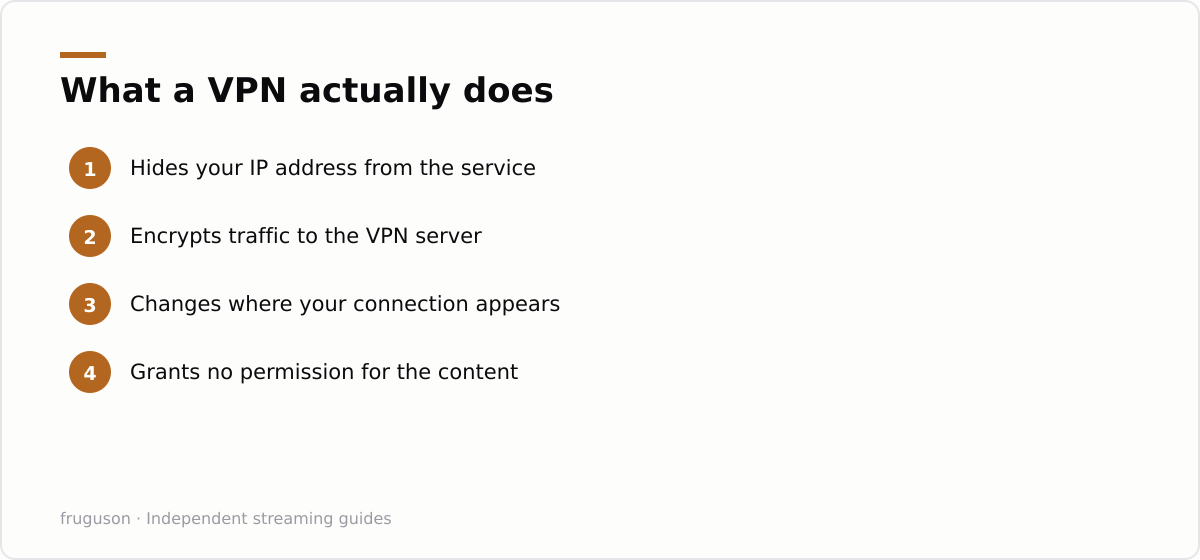
Here is where people talk themselves into trouble. They assume that because the VPN hides their address, it also erases the rules attached to whatever they are watching. It does no such thing. Concealing a number is not the same as earning permission, and the two get muddled constantly.
Geo blocking rules and why the terms still bind you
Streaming catalogues differ by country because of licensing. A film might be sold to one platform in Britain and a rival service in Spain. That is why a title disappears when you cross a border. These geo blocking rules are contract terms, baked into the deals between studios and platforms, not petty spite from the app.
When you sign up to a licensed service, you accept its terms. Almost every set says you will not misrepresent your location to reach content you hold no licence for. Using a VPN to pull a foreign catalogue does not break a criminal law in most everyday cases. It does break the agreement you signed. The platform can suspend or close your account over it, and plenty of them detect and block VPN traffic on sight.
That gap matters more than people realise. Breaching terms of service is a private dispute between you and the company. It sits a long way from the criminal exposure that trails pirate streams, which comes next.
Streaming with VPN on services you actually pay for
There are calm, legitimate reasons for streaming with VPN switched on. Security leads the list. On hotel or café wifi, encryption stops a stranger on the same network reading your traffic. Some people simply dislike their broadband provider logging every site they open, and a VPN closes that window.
For UK licensed services at home, though, a VPN usually adds friction rather than value. Freely and BBC iPlayer are built to serve you here. Point a VPN at a foreign server and many services refuse to play, because they enforce the same geo blocking rules from their own side. If your aim is reliable playback on the services you pay for, our rundown of the best IPTV services UK 2026 covers the licensed options that simply work without any of this bother. Getting the setup right on the telly itself matters too, and our guide to setting up IPTV on a smart-tv keeps that side straightforward.
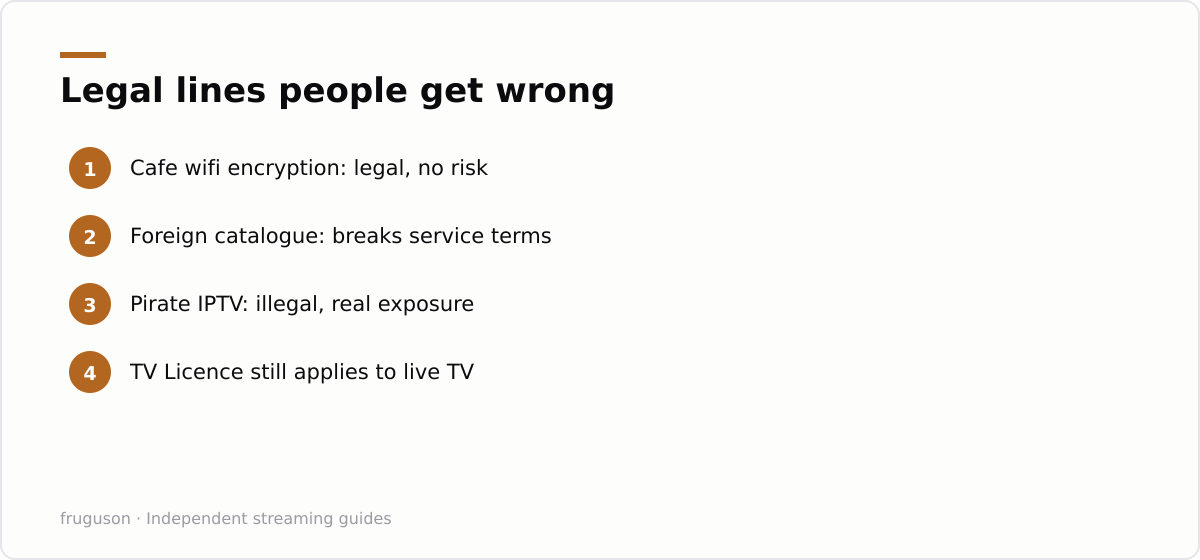
It helps to picture three situations side by side. Encrypting your traffic on café wifi is legal. It breaks no terms and creates no criminal risk. Reaching a foreign catalogue on a service you pay for is legal to attempt, though it usually breaches the terms you accepted. The criminal exposure there stays very small. Masking access to pirate IPTV is the odd one out: the tool stays legal, but the content itself is the offence, so the risk there is genuine.
The pirate IPTV trap a VPN will not fix
This is the part the resellers never spell out. A cheap subscription promising every Premier League match, every Sky channel and every new film for a fiver a month is not a licensed service. It is redistributing content it has no right to sell. A VPN for IPTV does not launder that. It hides your address from your broadband provider, but the stream stays unlicensed, and paying for it still funds an illegal operation.
UK authorities treat this seriously. The government laid out its position in its response to the call for views on illicit IPTV, published at https://assets.publishing.service.gov.uk/media/5bcd96e640f0b6441e6c38da/Gov-Response-call-for-views-Illicit-IPTV.pdf, and enforcement bodies act on it. The Federation Against Copyright Theft records its ongoing work on the crackdown on illegal IPTV services at https://www.fact-uk.org.uk/latest-crackdown-on-illegal-iptv-services/. Action has reached suppliers, and in some cases the people buying too.
A VPN does not change the legal character of what you watch. It might make you feel hidden. It does not make the content licensed, and it does not lift you beyond the reach of enforcement. When a deal looks far too cheap to be real, that price is the tell: the service is unlicensed. For a fuller look at where the line falls, our guide on whether IPTV is legal in the UK walks through it without scare tactics.
The TV Licence deserves a mention too. Watching any live TV, on any service, needs a licence, and so does anything on BBC iPlayer. A VPN has no bearing on that duty whatsoever. Tunnelling your connection changes none of it.
Does a VPN make you truly anonymous?
Not entirely, and this matters for the choices above. A VPN moves trust rather than removing it. Your broadband provider no longer sees which sites you visit, but the VPN company does, because your traffic runs through its servers. A reputable provider keeps no logs and sits in a sensible jurisdiction. A free VPN often pays its bills by selling the very browsing data you hoped to hide. So the privacy you gain depends entirely on who you picked, and that is worth weighing before you lean on one for anything sensitive.
None of that shifts the legal picture. Anonymity, even good anonymity, is not permission. A well chosen VPN protects your data on the way to a service. It never converts an unlicensed stream into a licensed one, and it never rewrites the terms you accepted when you signed up.
The verdict: keep the tool, drop the wishful thinking
Buy a VPN if you want encryption on untrusted networks or a little privacy from your broadband provider. That use is dull and perfectly fine. Just never treat it as a cloak that rewrites the law or the contract you agreed to.
The honest position stays simple. Licensed services earn their fee, and a VPN neither helps nor hurts much once you use them as intended. Pirate feeds remain illegal whether or not you tunnel the traffic, and the exposure lands on you, not on the software. Sort your kit and your subscriptions properly and this whole worry loses its sting. If you are building a setup from nothing, our notes on the best IPTV provider in the UK steer you toward licensed choices that keep you clear of the trap.
Frequently asked questions
Is it illegal to use a VPN for IPTV in the UK?
Using a VPN is legal in the UK, and so is running one alongside a licensed streaming service. What breaks the law is watching pirate IPTV feeds, and a VPN does not change that. The tool is fine; the unlicensed content is the problem.
Does a VPN hide illegal streaming from the authorities?
A VPN hides your browsing from your broadband provider, but it does not place you outside the reach of enforcement. UK bodies pursue both suppliers and, in some cases, buyers of illicit IPTV. Feeling hidden is not the same as being safe or being legal.
Can I use a VPN to watch a foreign Netflix catalogue?
You can try, but most licensed platforms detect and block VPN traffic, and doing so breaches the terms you accepted on sign-up. It rarely amounts to a criminal offence, yet the service can suspend or close your account. It is a contract issue rather than a police matter.
Summarize this post with:
Follow How To Watch Streaming on Google News so you never miss a new guide.



Leave a comment